

CSA Scores: Why They’re Destroying Your Insurance Rates

Written by Aliana G
December 16, 2025

Your CSA score is working against you in ways you might not realize.

What Most Fleet Owners Don’t Know About CSA Scores

Your CSA score doesn’t just affect DOT audits. It directly impacts:

  • Insurance premiums (your biggest variable cost)
  • Broker freight availability
  • Driver recruitment
  • Business opportunities (revenue!)

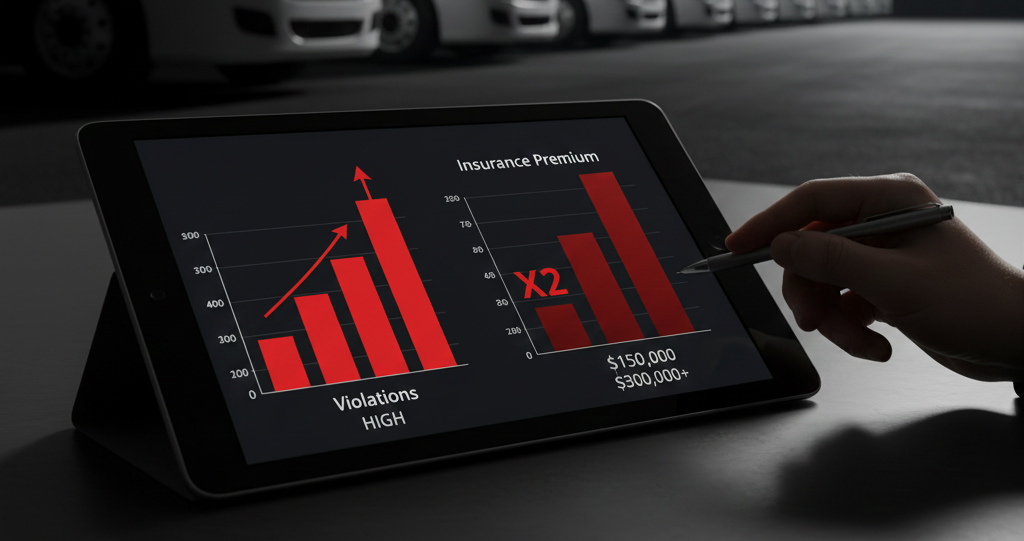
Just as personal driving records influence car insurance premiums, CSA scores affect the insurance rates for trucking companies. Higher scores, triggered by violations or incidents, often increase premiums as insurers view these companies as higher risk.

The Insurance Premium Multiplier

Insurance companies use a multiplier system to price in risk. Insurance companies usually price what they view as the best-performing companies at two times the expected or average annual claim costs. For those they believe to be poorer performing companies, the costs are often three to four times the expected or average claim costs.

That means a poor CSA score could be costing you double—or triple—your actual claim exposure. And with commercial insurance already hardening, carriers are seeing a 25-30% increase in commercial insurance premiums across the board…and it is across the board.

What a Good Score Actually Saves You

Fleets with low CSA scores can save up to 25% annually on insurance premiums, translating into substantial cost reductions for larger operations.

For a 50-truck fleet, that could mean $50,000-$100,000+ in annual insurance savings. That’s not a compliance issue. That’s a profit issue.

How DQ File Violations Damage Your CSA Score

Unsafe Driving and Driver Fitness are two of seven CSA categories. 60% of critical violations found during audits relate to recordkeeping, including 6 out of the top 10.

Ex. 1: Incomplete driver files => Non- Up-to-date MVR’s = Increased Audits = Additional Violations = Higher CSA score = Higher insurance costs.

Ex. 2: Incomplete driver files => Expired Medical Certificate = Direct Violation = Higher CSA score = Higher insurance costs.


It’s a chain reaction. And it starts with disorganized paperwork.

Protect your CSA score before it costs you.

Get Your Compliance Gap Report →

Start Your 30-Day Free Trial →

ComplyDQ: Automated driver file management that keeps your CSA score strong and your insurance costs down.

Sources:

  • Morais Agency: Impact of CSA Scores on Commercial Trucking Insurance Rates (2024)
  • Risk Strategies: How to Improve Your CSA Score (2024)

Related Posts

From Chaos to Confidence: One Fleet’s Audit Transformation

Managing 25 drivers manually = chaos. Medical certs expiring, docs scattered, audit fear constant. Then Mike switched systems. Result: zero violations, $18K saved.

2025 FMCSA Penalties: Why Your Compliance Budget Just Increased

2025 FMCSA penalties: $1,584/violation, $15,846 max. Small fleets averaging 10 violations = $15,840 in fines. Prevention costs $2,424/year. Do the math.

Inside the Mind of a DOT Auditor: What They’re Really Looking for

Modern DOT audits take minutes, not hours. Auditors check digital organization first, then DQ files. 60% of violations? Recordkeeping gaps. Know their checklist.

57% of DOT Audits Target Companies Like Yours (Here’s Why)

If you run 3-20 trucks, you’re a DOT audit target. 54% of audits hit small fleets with manual systems. It’s not random—it’s predictable. Here’s how to prepare.

The Real Cost of “Free” DQ File Management

You think driver file management is free? It’s costing $37K-$47K yearly. ComplyDQ costs $2,424 for 50 trucks. One violation avoided = 8 months paid for.

The 3 Red Flags Auditors Look for (And Why You Probably Have All Three)

Auditors know what fails before they walk in. Paper files, expired medical certs, missing MVRs—the 3 red flags costing fleets thousands. Eliminate them.

Paper vs. Digital: Why Your Filing Cabinet Is Costing You Thousands

Manual driver file management costs $26K-$39K yearly in labor alone. Paper files fail 48-hour audits, miss renewals, and create violations. Digital saves thousands.

The 48-Hour Warning: What Happens When You Get an Off-Site Audit Notice

The call comes in: FMCSA wants all your driver files submitted digitally in 48 hours. Can you do it? Off-site audits surged 400% and show no signs of slowing. With penalties starting at $1,584 per missing document, that two-day window can become very expensive, very fast. Paper files mean scrambling through cabinets and finding gaps. Digital files mean responding in hours with complete, organized records. Discover what auditors look for, why preparation matters, and how the right system turns audit stress into audit confidence.

Why 94% of Trucking Companies Fail Their First DOT Audit

94% of DOT audits result in violations. Learn why 60% stem from recordkeeping errors and how to avoid $1,544+ fines with proper DQ file management.

DQ Files- An Easy Breakdown

Explore essential strategies for managing Driver Qualification Files effectively. From understanding what to include to maintaining compliance, this guide offers crucial insights for transportation companies looking to safeguard their operations.