

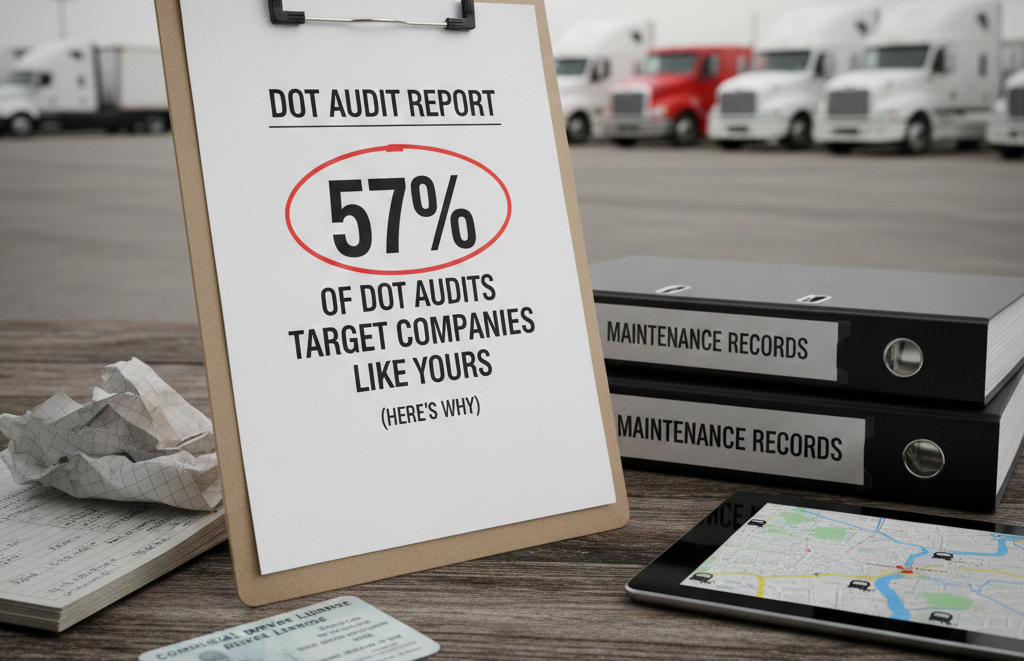
57% of DOT Audits Target Companies Like Yours (Here’s Why)

Written by Aliana G
December 16, 2025

If you’re running 3-20 trucks, you’re in the audit target zone.

The Uncomfortable Truth About Small Fleet Audits

Over half (54%) of companies that were audited had fewer than 7 power units.

This isn’t random. Auditors know that smaller fleets are more likely to:

  • Use manual file management systems
  • Have incomplete documentation
  • Miss renewal dates
  • Struggle with compliance complexity

It’s a predictable pattern. Which means it’s also predictable that you’ll be audited soon.

Why Auditors Target Small Carriers

Smaller companies often don’t have dedicated compliance staff. There’s no compliance director. There’s no team. There’s just youβ€”trying to manage drivers, maintenance, dispatch, and paperwork.

Auditors see this as an opportunity to find violations. And unfortunately for these companies, they usually do.

What “Ready” Looks Like

The small fleet owners who pass audits with zero violations have one thing in common: They’re not reinventing compliance. They’ve adopted systems that do the work for them.

Digital file management. Automated renewals. Organized documentation. Helping them always know what’s in good standing, what’s missing, and what is expiring soon.

These companies are not special (actually everyone one of our companies are😊). They’re just prepared and taking advantage of simple solutions.

Your Audit Window

Audits are random. But they’re not if you’re not ready. For the fourth year in a row, on-site audits continue to increase. If you fail an audit there can be cumulative effects, your likelihood of additional audits go up and your CSA scores go down.Β 

The question isn’t if you’ll be audited. The question is whether you’ll be ready when it happens.

Get ready before the knock on the door.

Start Your 30-Day Free Trial β†’

See Your Audit Risk Assessment β†’

ComplyDQ: Built for small fleets. Designed to help 3-50 as well as 100+ truck companies stay audit-ready every single day.

Sources:

  • FMCSA 2023 & 2024 Audits Year in Review
  • 2024 FMCSA audit data analysis (12,300+ investigations)

Related Posts

The Goal Isn’t Compliance. It’s Building a Practice That Doesn’t Own You.

You didn’t get into compliance services because you love tracking expiration dates across spreadsheets. You saw an opportunity to build a practice that solved a real problem for small fleet owners β€” reliably and professionally. The compliance work is the floor, not the ceiling. But when managing it manually takes over your business, something’s broken.

How to Build a Scalable DQ File System Across Multiple Client Accounts

Managing DQ files for one client is manageable. Managing them for ten, twenty, or fifty clients β€” each with their own drivers, expiration dates, and audit exposure β€” is a different problem entirely. The system that got you started won’t be the system that keeps you compliant at scale.

The Auditor Walked Into Your Client’s Office at 9 a.m. What Does the Next Two Hours Look Like for You?

On-site audits now represent more than 8 in 10 FMCSA investigations. Here's exactly what auditors are looking for. What the data says: In 2024, more than 8 in 10 FMCSA audits were conducted on-site β€” for the 4th consecutive year of increase. On-site audits uncover...

You Can’t Grow Your Client Roster If You’re Drowning in Compliance Work for the Accounts You Already Have

Manual DQ management doesn't just cost time. It directly caps how many clients you can serve. What the data says: Manual DQ file management runs 10–15 hours per week per small fleet β€” nearly two full workdays of staff time per account, per week. Each new driver a...

New Driver Onboarding Is Where Your Clients’ Files Go Wrong. It Doesn’t Have to.

The DQ file starts at hire. Get it right from day one and you never have to rebuild it. What the data says: Required at hire: Signed employment application (all jobs, last 3 years; all CMV jobs, last 10 years) β€” 49 CFR 391.21 MVR from every licensing state β€” must be...

Your Client Just Got a Satisfactory Rating. Did Your DQ Files Have Anything to Do With It?

When your client passes an audit cleanly, do they know you’re the reason? If compliance only gets noticed when something goes wrong, you’re delivering value your client can’t see β€” and that’s a retention problem that starts with the DQ file.

What Got You Here Won’t Get You to the Next Level β€” And Most Firms Find Out Too Late.

Compliance requirements don't scale down for small fleets. Your capacity does β€” and that's where gaps form. What the data says: 65% of all critical violations found in FMCSA audits relate to recordkeeping β€” including 7 of the top 10 violation categories. The #1 acute...

Is busy work impending your ability to grow? Let us help you with automation.

Every hour spent chasing paperwork across client accounts is an hour not spent growing your practice. With 35% of fleets still relying on spreadsheets and manual DQ file management costing upwards of 780 hours per client annually, the system isn’t working β€” and it’s capping your growth.

Every Fleet You Manage Has the Same Compliance Requirements. Your Tools Should Too.

DQ file requirements under 49 CFR 391.51 apply equally to a 3-truck operation and a 300-truck operation β€” but most compliance service providers are still managing dozens of client accounts across spreadsheets, shared folders, and calendar reminders. Here’s why that breaks down, and what a purpose-built solution looks like.

Your Client Found Out About the Violation after the Audit. They’re Wondering Why You Didn’t Tell Them First.

When an FMCSA auditor finds a recordkeeping gap in a driver qualification file, your client’s first question isn’t about the fine β€” it’s about why they were paying someone to handle this. 57% of 2024 audits targeted small fleets. Nearly 1 in 4 got fined. Here’s what DQ file gaps actually cost compliance service providers.