

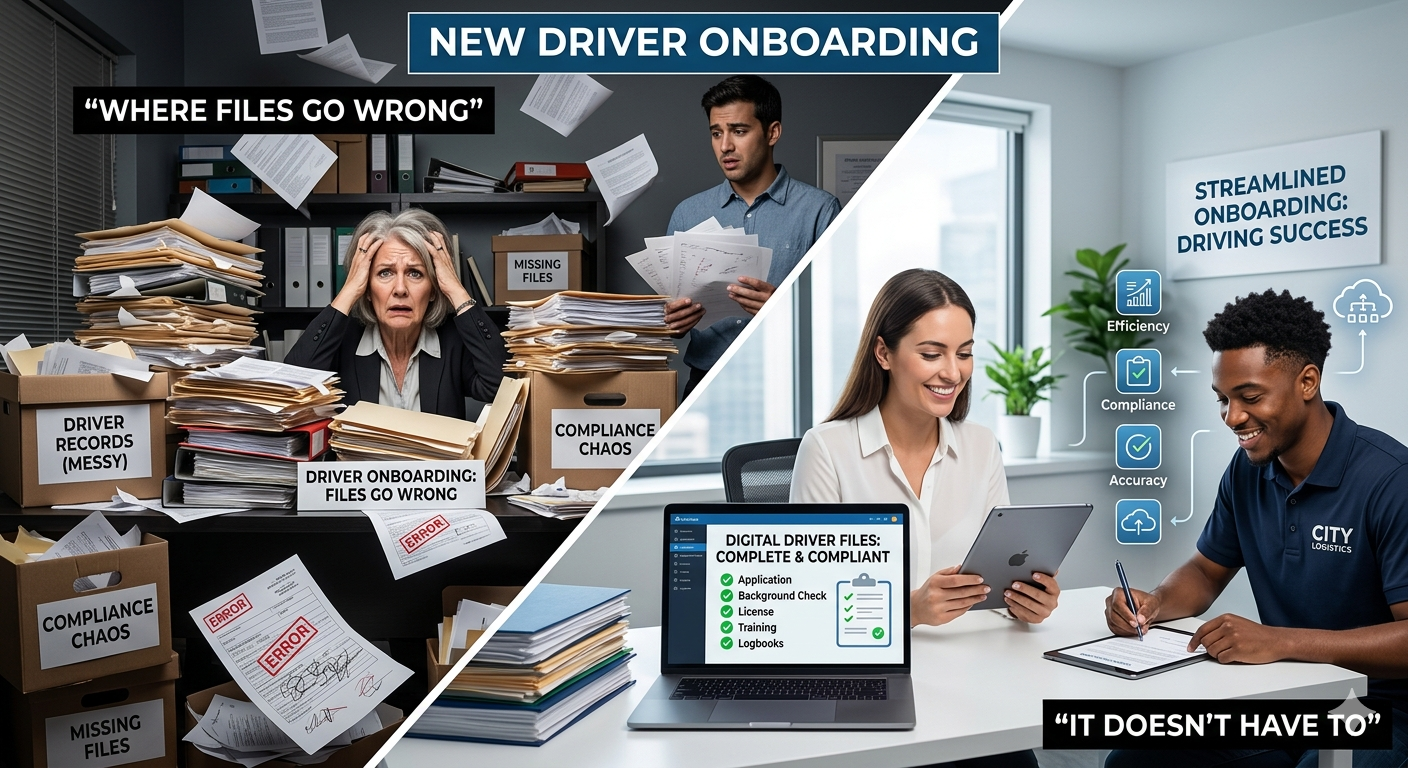
New Driver Onboarding Is Where Your Clients’ Files Go Wrong. It Doesn’t Have to.

Written by Aliana G
May 18, 2026

The DQ file starts at hire. Get it right from day one and you never have to rebuild it.

What the data says:

  • Required at hire: Signed employment application (all jobs, last 3 years; all CMV jobs, last 10 years) — 49 CFR 391.21
  • MVR from every licensing state — must be obtained within 30 days of hire — 49 CFR 391.23
  • Medical certificate — on file before driver operates any CMV — 49 CFR 391.41
  • Pre-employment Clearinghouse query — required as of Jan. 6, 2023 — 49 CFR 382.701
  • Safety performance history investigation — previous CMV employers, past 3 years — 49 CFR 391.23

Source: FMCSA Driver Qualification File Checklist (49 CFR 391.51); FMCSA Motor Carrier Safety Planner.

Your client found a good driver. CDL, clean record, references that check out. Exactly who they need. They tell you they’re hiring. Then comes your job: building the DQ file correctly from day one so it never has to be rebuilt.

Federal regulations require a complete DQ file before that driver turns the key on any CMV. Under 49 CFR 391.51, every file must contain: a completed employment application listing all work for the last 3 years and all CMV employment for the last 10 years; an MVR from every licensing state requested within 30 days of hire; a current medical certificate; and pre-employment drug test results. As of January 6, 2023, a pre-employment Clearinghouse query is also required under 49 CFR 382.701 — and it replaces the previous manual inquiry requirement.

The problem for service providers managing multiple accounts isn’t knowing the requirements. It’s having a reliable process that executes them correctly, every time, at every client account, without falling back on whoever on your team happened to onboard the last new hire.

Because six months after onboarding, when an auditor asks for that pre-employment drug test result or the safety performance history investigation, “we gathered what we could at the time” isn’t an answer your client — or their auditor — will accept. The employment application alone — incomplete or missing — is one of the most commonly cited FMCSA recordkeeping violations.

ComplyDQ gives you a standardized onboarding checklist for every new driver at every client account. Every required document has a place. When onboarding is complete, the file is complete — and the system starts tracking what needs to be renewed automatically.

No more ad hoc onboarding. No more missing documents discovered at audit. Simple, predictable pricing that works for service provider portfolios of any size. Book a discovery call to see the onboarding workflow firsthand.

Sources & References

49 CFR 391.21 — Application for employment — 3-year employment history; 10-year CMV history for CDL drivers
49 CFR 391.23 — Investigation and inquiries — MVR within 30 days; safety performance history investigation
FMCSA Motor Carrier Safety Planner — DQ File Requirements — Official DQ file document checklist
FMCSA Clearinghouse pre-employment query requirement (49 CFR 382.701) — Mandatory as of Jan. 6, 2023 for FMCSA-regulated employers

Related Posts

The Goal Isn’t Compliance. It’s Building a Practice That Doesn’t Own You.

You didn’t get into compliance services because you love tracking expiration dates across spreadsheets. You saw an opportunity to build a practice that solved a real problem for small fleet owners — reliably and professionally. The compliance work is the floor, not the ceiling. But when managing it manually takes over your business, something’s broken.

How to Build a Scalable DQ File System Across Multiple Client Accounts

Managing DQ files for one client is manageable. Managing them for ten, twenty, or fifty clients — each with their own drivers, expiration dates, and audit exposure — is a different problem entirely. The system that got you started won’t be the system that keeps you compliant at scale.

The Auditor Walked Into Your Client’s Office at 9 a.m. What Does the Next Two Hours Look Like for You?

On-site audits now represent more than 8 in 10 FMCSA investigations. Here's exactly what auditors are looking for. What the data says: In 2024, more than 8 in 10 FMCSA audits were conducted on-site — for the 4th consecutive year of increase. On-site audits uncover...

You Can’t Grow Your Client Roster If You’re Drowning in Compliance Work for the Accounts You Already Have

Manual DQ management doesn't just cost time. It directly caps how many clients you can serve. What the data says: Manual DQ file management runs 10–15 hours per week per small fleet — nearly two full workdays of staff time per account, per week. Each new driver a...

Your Client Just Got a Satisfactory Rating. Did Your DQ Files Have Anything to Do With It?

When your client passes an audit cleanly, do they know you’re the reason? If compliance only gets noticed when something goes wrong, you’re delivering value your client can’t see — and that’s a retention problem that starts with the DQ file.

What Got You Here Won’t Get You to the Next Level — And Most Firms Find Out Too Late.

Compliance requirements don't scale down for small fleets. Your capacity does — and that's where gaps form. What the data says: 65% of all critical violations found in FMCSA audits relate to recordkeeping — including 7 of the top 10 violation categories. The #1 acute...

Is busy work impending your ability to grow? Let us help you with automation.

Every hour spent chasing paperwork across client accounts is an hour not spent growing your practice. With 35% of fleets still relying on spreadsheets and manual DQ file management costing upwards of 780 hours per client annually, the system isn’t working — and it’s capping your growth.

Every Fleet You Manage Has the Same Compliance Requirements. Your Tools Should Too.

DQ file requirements under 49 CFR 391.51 apply equally to a 3-truck operation and a 300-truck operation — but most compliance service providers are still managing dozens of client accounts across spreadsheets, shared folders, and calendar reminders. Here’s why that breaks down, and what a purpose-built solution looks like.

Your Client Found Out About the Violation after the Audit. They’re Wondering Why You Didn’t Tell Them First.

When an FMCSA auditor finds a recordkeeping gap in a driver qualification file, your client’s first question isn’t about the fine — it’s about why they were paying someone to handle this. 57% of 2024 audits targeted small fleets. Nearly 1 in 4 got fined. Here’s what DQ file gaps actually cost compliance service providers.

The New Entrant Advantage: Why Starting With Digital DQ Files Saves You Thousands

New carriers save $50,000+ by starting with digital DQ files from Day 1. Learn why manual compliance costs 520 hours annually and how to eliminate that burden.